
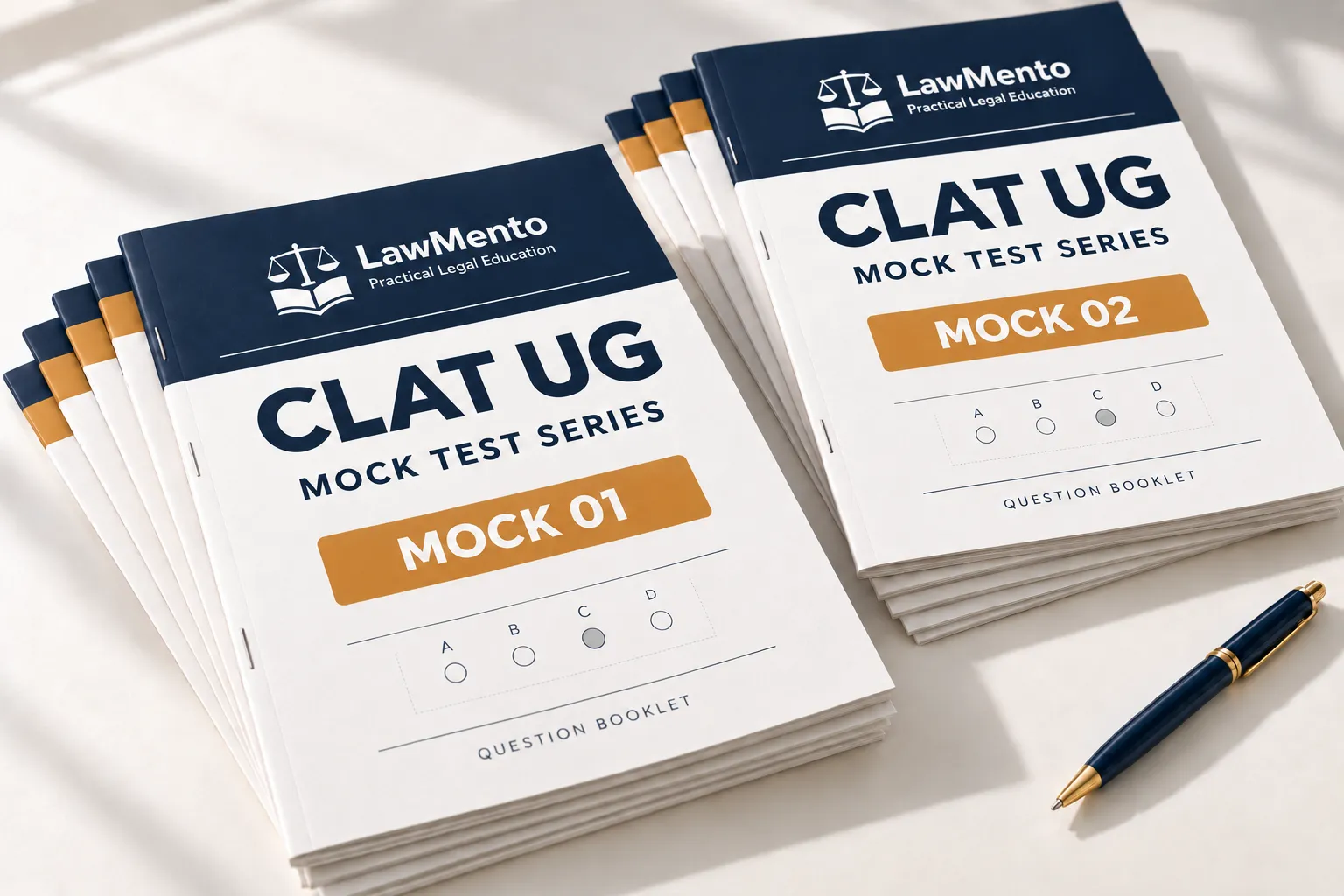
CLAT UG Mock Test Series – 10 Full-Length Mocks
Prepare for CLAT UG 2027 with 10 full-length mock tests featuring answers and explanations. Practise passage-based questions, strengthen your reasoning skills and develop a realistic two-hour examination strategy.
CLAT UG Is About Reading, Reasoning and Making the Right Decisions
The Common Law Admission Test for undergraduate programmes evaluates comprehension, analytical thinking, logical reasoning and your ability to interpret information under pressure.
CLAT UG is different from examinations that primarily test memorised facts. A large part of the paper requires candidates to read passages, identify relevant information and answer questions carefully.
Even if you are comfortable with English comprehension, current affairs and legal reasoning, managing all five sections in a two-hour paper can be challenging.
Full-length mocks help you determine whether your reading speed, accuracy and question-selection strategy are effective under examination conditions.
With answers and explanations, you can also review incorrect responses and understand the reasoning behind the correct options.
The objective is not only to attempt more questions, but to learn from each attempt and improve your score.
What Can a CLAT UG Mock Reveal?
- Whether you can complete 120 questions in two hours
- Which sections consume the most time
- Whether lengthy passages affect concentration
- Which question types repeatedly reduce accuracy
- How negative marking influences your score
- Which concepts need revision after each mock
Practise the Paper. Understand Every Mistake.
Get 10 full-length CLAT UG mocks with answers and explanations for just ₹699.
CLAT UG 2027 Examination Pattern
According to the Consortium of National Law Universities, CLAT UG 2027 consists of 120 multiple-choice questions carrying one mark each, with a total duration of two hours.
| Exam Component | CLAT UG 2027 Format |
|---|---|
| Maximum Marks | 120 |
| Total Questions | 120 MCQs |
| Exam Duration | 120 Minutes (2 Hours) |
| Marks Per Correct Answer | +1 Mark |
| Negative Marking | −0.25 Mark for Each Wrong Answer |
| Exam Mode | Offline |
| Number of Sections | 5 |
| Scheduled Exam Date | 6 December 2026 |
CLAT UG Subject-Wise Question Distribution
The Consortium provides approximate question ranges for the five sections of CLAT UG. These are indicative, and the final distribution may vary.
| Subject | Approximate Questions | Approximate Weightage |
|---|---|---|
| English Language | 22–26 | 20% |
| Current Affairs, Including General Knowledge | 28–32 | 25% |
| Legal Reasoning | 28–32 | 25% |
| Logical Reasoning | 22–26 | 20% |
| Quantitative Techniques | 10–14 | 10% |
10 Full-Length Mocks With Answers and Explanations
Practise the complete CLAT UG question format and use the answers and explanations to understand where you went wrong.
10 Full-Length Mock Tests
Ten complete practice papers designed for CLAT UG preparation.
Answers Included
Review the correct answers after attempting the mocks.
Answer Explanations
Understand the reasoning behind answers and learn from incorrect responses.
120 Questions Per Mock
Practise the overall question volume of the official examination.
All Five CLAT Sections
Work across English, GK, Legal Reasoning, Logical Reasoning and Quantitative Techniques.
Passage-Based Practice
Improve reading comprehension, interpretation and reasoning through practice.
Exam-Pattern Preparation
Practise using the current CLAT UG examination structure.
Revision Support
Use explanations to identify concepts that need additional revision.
What Are the Five Sections of CLAT UG?
The CLAT UG syllabus focuses primarily on comprehension and reasoning ability. Each section evaluates different skills relevant to undergraduate legal education.
English Language
Develop reading comprehension, vocabulary in context, inference and interpretation skills through passages.
Current Affairs, Including General Knowledge
Test awareness of important national and international developments through passage-based questions.
Legal Reasoning
Practise identifying legal principles and applying them to factual situations. Prior formal legal education is not required.
Logical Reasoning
Strengthen the ability to identify arguments, draw conclusions and evaluate patterns of reasoning.
Quantitative Techniques
Practise interpreting numerical information presented in short passages, tables and data sets, using mathematical operations generally taught up to Class 10.
Why Are Answers and Explanations Important?
Attempting a mock tells you how you performed. Reviewing its answers and explanations helps you understand what needs to improve.
Understand Incorrect Answers
Instead of simply marking an answer as wrong, use the explanation to understand the correct reasoning.
Learn to Eliminate Options
Explanations can help you recognise why an option does or does not follow from the passage.
Revise More Effectively
Identify the types of questions that require attention and return to those concepts before the next mock.
Your Mock-Test Review Routine
After completing a mock, begin by checking your incorrect and uncertain responses.
Read the relevant explanations carefully. Try to identify whether the mistake resulted from misunderstanding the passage, using an incorrect reasoning approach or missing an important fact.
Then return to the relevant topic or skill before attempting another mock.
Review Checklist
- Review incorrect questions
- Read the explanations
- Check uncertain correct answers too
- Identify repeated mistakes
- Revise the relevant concepts
- Apply the learning in your next mock
A Mock Test Is More Useful When You Understand the Answers.
Practise with 10 full-length CLAT UG mocks, complete with answers and explanations, for ₹699.
How Should You Use the 10 CLAT UG Mocks?
Use the series as a structured preparation tool rather than attempting every paper without review.
Attempt a Full Mock
Practise all five sections together within the two-hour examination limit.
Review the Answers
Check incorrect and uncertain responses with the supplied answers and explanations.
Revise Weak Areas
Focus on the passages, question types or subjects where mistakes occurred.
Attempt the Next Mock
Apply the lessons learned and work towards better timing and accuracy.
What Can You Improve Through CLAT UG Mock Practice?
Reading Speed
Learn to read passages efficiently without missing important details.
Legal Reasoning
Apply principles provided in passages to different factual scenarios.
Logical Accuracy
Improve your understanding of arguments, conclusions and inferences.
Time Management
Develop a workable approach to completing five sections in two hours.
Question Selection
Become more confident deciding when to attempt, revisit or skip a question.
Exam Temperament
Become more comfortable handling lengthy passages and examination pressure.
Who Can Benefit From CLAT UG Mock Tests?
Full-length mock practice is useful whether you are taking CLAT UG for the first time or looking to improve an earlier examination performance.
Class 12 Students
Aspirants preparing for undergraduate law entrance examinations alongside school.
First-Time Aspirants
Candidates who want to understand the complete CLAT UG question format.
Repeat Aspirants
Candidates aiming to improve accuracy and examination strategy.
Self-Study Candidates
Aspirants preparing independently who need complete-paper practice.
Revision-Stage Aspirants
Students who have covered the main preparation areas and need exam-oriented practice.
Students Targeting NLUs
Aspirants preparing for five-year integrated law programmes at participating National Law Universities.
Why Full-Length Mock Practice Matters
| Without Regular Mock Practice | With Structured Mock Practice |
|---|---|
| Reading speed remains difficult to measure | Passage-solving pace can be tested under time pressure |
| Preparation stays focused on individual subjects | All five sections can be practised together |
| Repeated mistakes may go unnoticed | Answers and explanations help identify errors |
| Negative marking is understood only theoretically | Attempt decisions become part of mock practice |
| Exam-day conditions may feel unfamiliar | Repeated full-paper practice builds familiarity |
Questions About the CLAT UG Mock Test Series
How many CLAT UG mock tests are included?
The series includes 10 full-length CLAT UG mock tests.
Are answers and explanations included?
Yes. The series includes answers and explanations to help you review questions and learn from mistakes.
What is the price of the mock series?
The complete series is priced at ₹699 as a one-time fee.
How many questions are there in each mock?
Each full-length mock is designed around the current 120-question CLAT UG examination format.
What is the duration of CLAT UG 2027?
The official CLAT UG 2027 examination duration is two hours, or 120 minutes.
Is there negative marking in CLAT UG?
Yes. The current pattern deducts 0.25 marks for every wrong answer.
Which sections are covered?
The series covers English Language, Current Affairs including General Knowledge, Legal Reasoning, Logical Reasoning and Quantitative Techniques.
Do I need prior legal knowledge for CLAT UG?
No formal legal education is required for the Legal Reasoning section. Questions primarily test your ability to understand and apply principles given in passages.
Are these mocks designed for CLAT UG 2027?
Yes. The series is intended for CLAT UG 2027 preparation using the current examination format.
Should I attempt all ten mocks immediately?
It is generally more useful to attempt a mock, review answers and explanations, revise weak areas and then attempt the next.
Are the mocks online or offline?
The LawMento mock series is an online preparation resource. The official CLAT UG examination is conducted offline.
Can the mock test series guarantee an NLU seat?
No. Mock tests are preparation resources. Admission depends on examination performance, counselling, eligibility and applicable admission criteria.
₹699 for 10 CLAT UG Mocks With Answers and Explanations
Practise all five sections, learn from your mistakes and prepare with greater confidence for CLAT UG 2027.